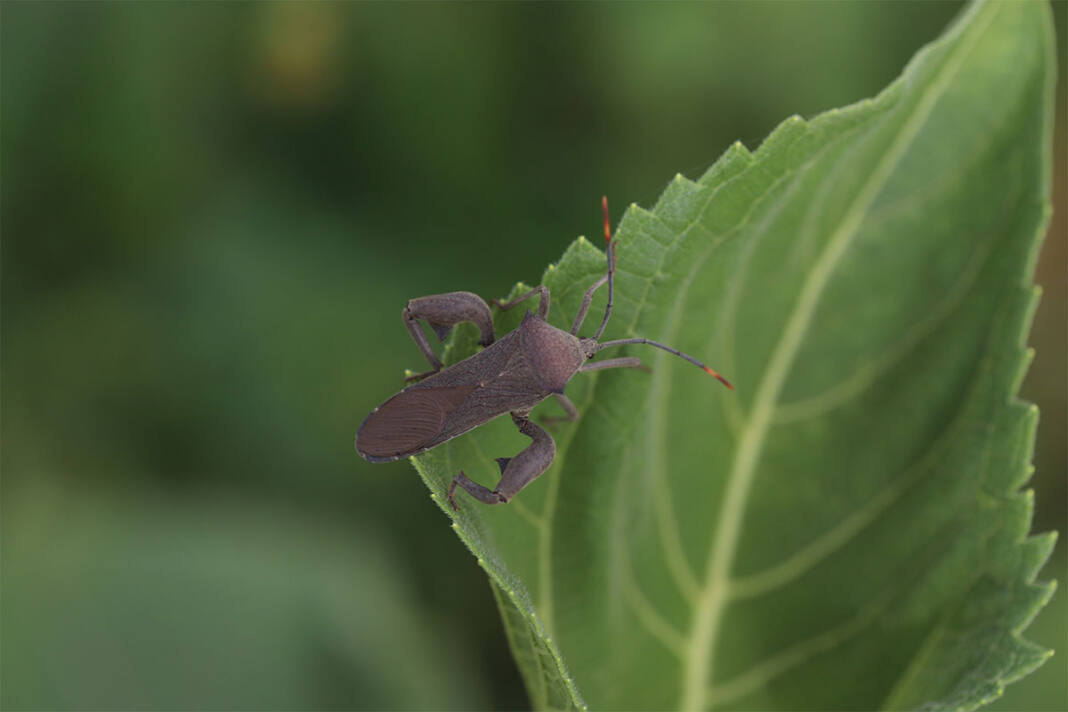
Sucking pests: the silent threat to soya bean crops
Sucking pests are often overlooked in soya bean fields because they leave little visible damage. Yet under the right conditions these insects can rapidly build up populations and cause significant yield losses if they are not detected early.
Pest differentiation
Unlike chewing insects that leave visible physical damage like defoliation, pod holes, and larval frass, sucking pests feed through needle-like mouthparts called stylets, extracting plant fluids with little outward trace. Most belong to the order Hemiptera and include stink bugs, aphids, leafhoppers and whiteflies. Thrips and red spider mite are often grouped with them, though both differ in feeding biology: thrips rasp and suck, while mites are arachnids, not insects.
In South African soya bean production, sucking pests are generally considered secondary pests. Lepidopteran pests like African bollworm and soya bean looper remain the primary concerns. Venter, however, cautions against complacency.
“Their importance may increase with climate change and expanding soya bean acreage in South Africa,” he says.
Venter adds that different pests have different triggers. Aphids can reproduce without mating and cycle through multiple generations in as little as 7 to 10 days; populations spike under cool-to-moderate conditions between 15°C and 25°C.
Spider mites prefer hot, dry conditions above 30°C, with drought stress accelerating outbreaks, while stink bugs target the crop during the reproductive stages, with R3 to R6 the highest-risk window. Weeds and surrounding vegetation amplify the pressure.
“Untreated weeds can harbour many pests and are major pathways of inoculation in most crops,” says Venter.
Aphids and whiteflies also vector viral pathogens from infected vegetation into the crop, compounding damage well beyond direct feeding alone.
Venter says that research on sucking pests in South African soya beans remains limited relative to chewing pests, which have historically been the main invertebrate targets. He adds that gaps persist around locally validated economic impact levels, resistance development, and how changing climate patterns are shifting pest dynamics.
Spotting the damage
Each pest leaves a distinct signature. Aphid infestations cause leaf curling, yellowing and stunting, with heavy populations producing honeydew deposits that lead to sooty mould and potential virus transmission.
Spider mite damage begins as fine stippling or bronzing on the lower leaves, progressing to yellowing, desiccation and premature leaf drop in severe cases. Venter says that fine webbing on leaf undersides is usually confirmation.
Stink bug feeding is stage dependent. Signs can be distorted terminals on young plants or shrivelled, discoloured or aborted seeds and flattened pods during pod-fill.
Venter adds that confusing sucking pest damage with nutrient deficiencies is a common error. Pattern and distribution are the key diagnostic tools. Nutrient deficiencies tend to be uniform across a field. Spider mite bronzing typically begins at field margins and progresses inward from the lower canopy. He says that high mite presence alongside bronzing symptoms confirms the diagnosis.
What’s at stake
Sucking pests only sporadically cause major economic harm in South African soya beans. But when they do, it is typically because control came too late. Pod-feeding stink bugs inflict direct seed and quality losses during the R3 to R6 window that are difficult to recover from once the critical period has passed.
Spider mite pressure is most severe in the hotter, drier production areas of the summer rainfall region. Delayed rains, extended heatwaves and excessive wind all drive population build-ups. Infestation severity and the timing of intervention are the two variables that ultimately determine yield outcome.
Control
Scouting is the foundation of any spray programme.
“The most critical error in pest control is generally when it is ignored or noticed too late,” says Venter.
Weekly field walks during the season is the minimum. The full plant must be inspected: stems, petioles, leaves and pods. He adds that scouting frequency must be increased during R3 to R6.
Correct pest identification before product selection is another non-negotiable. Modern chemistry is increasingly target-specific, and a wrong choice can actively worsen an infestation.
“Applying a miticide will do little to control stink bugs, but applying a general broad-spectrum insecticide could worsen mite infestations,” Venter warns.
Red spider mite control in soya beans is largely dominated by avermectins, classed as Group 6, one of the few chemical groups registered specifically for mites in the crop.
Systemic and translaminar products are generally better suited to sucking pests, which tend to be cryptic feeders. Contact products deliver a faster knockdown but require precise application to reach the target. Venter says that nozzle selection, water volume, water pH and tank-mix order all affect performance. Equipment must be calibrated and cleaned regularly.
“Unfortunately, many farmers are still applying preventatively, which will reduce the efficacy of the products. Integrated approaches should always be followed to ensure application of insecticides only when needed,” he says.
Integrated pest management
Venter consistently returns to a straightforward principle: “As much as needed, as little as possible.”
Chemical intervention should be driven by scouting confirmed thresholds, not scheduling or preventative habits. Venter says that, where possible, farmers must spray during the evening or early morning when pollinators are inactive. Additionally, growers should avoid applications during bloom and prioritise selective chemistry over broad-spectrum options that disrupt natural enemy populations.
Broad-spectrum organophosphates and pyrethroids can suppress beneficial insect populations that would otherwise keep pest numbers in check. Venter says that spot treatments, refuge strips along field margins, and reduced-rate combinations with biological controls help preserve these beneficial insects. Monitoring both pest and beneficial populations through regular scouting allows producers to decide whether intervention is necessary at all.
Looking ahead, Venter expects improved application technology and advanced scouting tools to become more accessible to South African soya bean producers. Biological controls and more target-specific chemistries are in development globally and will expand local integrated pest management capabilities.
Sucking pests may not command the same attention as bollworm in South African soya bean fields, but their potential impact, particularly during drought years or heatwaves, cannot be ignored. With sound scouting habits, correct pest identification, and disciplined chemistry choices, producers have the tools to manage them effectively.
Source: Farmersweekly.co.za