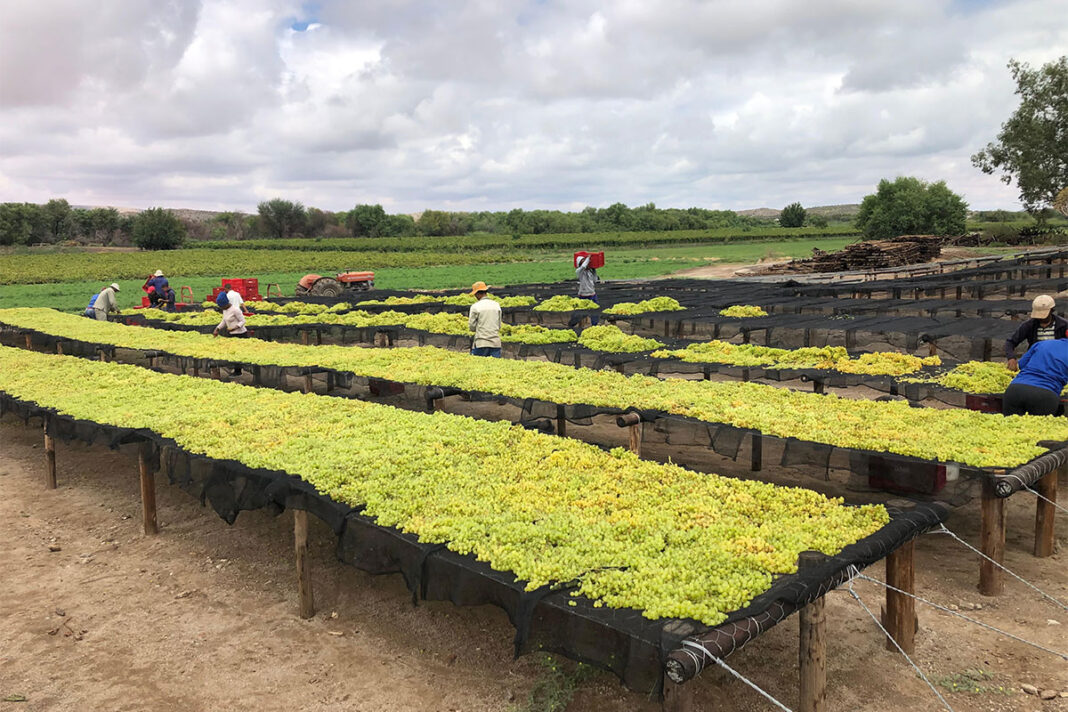
Precision and discipline drive success on Northern Cape raisin farm
On his farm Alpat, near Keimoes in the Northern Cape, Albertus van der Merwe’s raisin vineyards are a study in control and precision. The vines are uniform and perfectly balanced, cover crops between the rows look combed into place, and the soil is clean, even and weed-free.
Every element reflects deliberate decision-making, where nothing is left to chance and even the smallest detail serves a clear production purpose, reflecting Van der Merwe’s candid admission that he is a ‘complete control freak’.
What makes this even more extraordinary is that Van der Merwe maintains this level of precision despite his diverse farming commitments. In addition to his raisin enterprise, he runs a 24 000ha cattle operation on rented land in the Kalahari, keeps sheep and game, spends three months a year overseas making wine for the Tohani winery in Romania, buys grapes from emerging farmers in South Africa to produce wine locally, and until the end of 2025, his wife, Patricia, owned the local butchery, Kalahari Vleishuis.
“I’m a third-generation butcher and ran the business for 23 years. I started with five staff, which grew to more than 30. It’s a demanding job. I sold the business because the hours are so long that you start to forget how to switch off,” says Patricia, dashing past during the interview with Van der Merwe.
A strong team
Van der Merwe worked at Distell for almost two decades, during which time he raised cattle on rented land as a hobby. After crossing paths with Patricia, the two decided to turn their long-distance relationship into a shared life and farming venture, and he bought land along the Orange River near Keimoes around 2009, at the age of 47.
“Looking back, I don’t regret not becoming a full-time farmer sooner,” he says. “Distell opened the doors to Romania, and the corporate world not only taught me discipline, systems thinking, and the value of making decisions based on facts rather than emotion, but also about people.
“You learn quickly that success depends on clear communication, trust, and accountability, and those principles translate directly into farming,” he says.
It also taught him to manage his own perfectionism. For many farmers, perfectionism can be a curse, leading to over-management, delayed decisions, and the chasing of unrealistic standards in an industry shaped by weather, biology, and volatile markets.
However, Van der Merwe has learnt to turn it into a weapon; to build systems, enforce consistency, and turn attention to detail into measurable results. It is a mindset that earned him Raisins South Africa’s Most Improved Grower of the Year award in 2025, which recognises growers who achieve remarkable improvement in a short time through focused application of new technologies and practices.
A big part of his success comes down to people.
“I have an exceptional farm manager and a dedicated team who understand the what, how, and why of what they are doing, ensuring that high standards and attention to detail extend beyond me across the entire farming operation,” he explains.
Having a good sense of humour and relationship with his staff helps to keep the pace on Alpat from becoming relentless. Van der Merwe chuckles as he recalls the constant ribbing from his workers, who often joke that he should head back overseas or disappear to the Kalahari, because his presence stresses the vineyards.
But behind the jokes is a clear expectation, and Van der Merwe is firm when it comes to standards: “I do not repeat instructions. Rules are rules, and everyone has key performance indicators they must meet. If someone is unsure about something, they can ask the farm manager, call me, or send a WhatsApp. It’s simple; clarity prevents mistakes and keeps things moving.”
Yet, for all his attention to detail, he is far from a micromanager and understands that high-performing teams need autonomy to flourish.
“I give space for innovation. People learn by doing, by experimenting and, yes, sometimes by making mistakes. It’s like a braaibroodjie; you’ll probably burn it the first time, but that’s how you learn to get it right,” he explains.
In this balance between discipline and freedom, Van der Merwe has built a team that thrives on structure but is encouraged to think, adapt and take ownership. It’s a leadership style that keeps the vineyards immaculate, the workers engaged, and the farm running like clockwork, even when he’s away.
Technology also enables the smooth running of the farm. WhatsApp is Van der Merwe’s invisible hand across the farm and beyond, letting him coordinate tasks, monitor progress, and share photos instantly.
“People know that when I send a WhatsApp, it’s time to act, and it is easy to share photos to show exactly what is happening,” he says.
Do it right the first time
With a capable team in place and clear systems guiding daily work, Van der Merwe can focus on another crucial element of success: doing the right thing at the right time and never cutting financial corners. After all, even the most diligent workforce can only achieve their full potential when the farm itself is properly resourced.
“It’s like washing dishes,” he says, smiling. “Everybody knows how, but not everyone has the right sponge or enough soap to do a proper job. Farming works the same way; you might know what should be done, but without the right tools or enough money and resources, you won’t get far.
“Cutting corners always comes back to bite you, through lower yields, weaker crops, or extra work down the line. You get back exactly what you put in,” he adds.
Preparation on Alpat often starts two years before new vineyards are established. The soil is deep-ripped twice with a D8 Caterpillar to optimise growing conditions for the vine roots and break up any compaction layers, and a laser is used to ensure uniform flood irrigation. The entire trellis structure is erected in advance, ready for the vines to be planted.
Cover crops are planted in 1,2m strips between the 3m-wide vineyard rows to break the vineyard monoculture and suppress weeds, starting with oats worked into the soil at the end of the season, followed by lucerne.
Once the vines are planted, the lucerne is cut regularly before flowering and spread as mulch along the rows to protect the roots from extreme temperatures, reduce evaporation, and provide a favourable habitat for soil organisms. The lucerne’s deep taproots also help aerate the soil and fix nitrogen when managed properly.
Nutrient imbalances are corrected before planting, and around 3t of gypsum per hectare are usually added.