IrriCheck

IrriCheck's Irrigation Scheduling System
Written by Bertus vd Westhuizen   

The Irricheck Approach

The most outstanding feature of the system is that although it integrates a lot of technical detail, the end user level is very simple, enabling managers to delegate the normally time consuming task of irrigation scheduling to low levels of management.

The irrigation operators only need to know how to download and import the soil moisture data and how to see and print the recommendation.


The Irrigation Recommendation

The Irricheck program recommends the timing and quantities of the required irrigations to meet the simulated water use of the crop on each field.


Irricheck recommendations
The manager can check the results whenever it suits his schedule, because all the data is saved and summarized automatically.  The continuous data on water in the soil, indicating every irrigation and depth of wetting and the summarized depletion in the top and bottom soil together with the actual, predicted and long term average evaporative demand.


Irricheck Demo Graphs


During the execution of the recommended irrigation, operators make notes on the printed recommendation, indicating any deviations from the plan and the reasons for it. This record is filed next to the computer enabling the manager and the consultant to interpret deviations from the plan. 


Normally the system will be serviced by an external consultant, who is responsible for the following:

  • Setting up the program, the weather station and the general options in the program
  • Setting up fields with info of the crop, soil, probes, irrigation system, weather data and weather forecast areas, etc
  • Setting field capacity levels for each measured layer and refining it regularly as it varies slightly over time
  • Calibrating the % probe readings to mm/m of water in each field More detail on calibration
  • Setting application rates and other irrigation system variables
  • Setting crop coefficients and refining them according to measured water use and measured evaporative demand
  • Determining (for each field) the depletion level where first crop water stress occurs, which should be the maximum depletion level for irrigation.  See more detail on this.
  • Ensure that the farmer and his operators understand the system
  • Ensure that important information is noticed by the farmer and his operators 

The simulation model


Irricheck Scheduling System


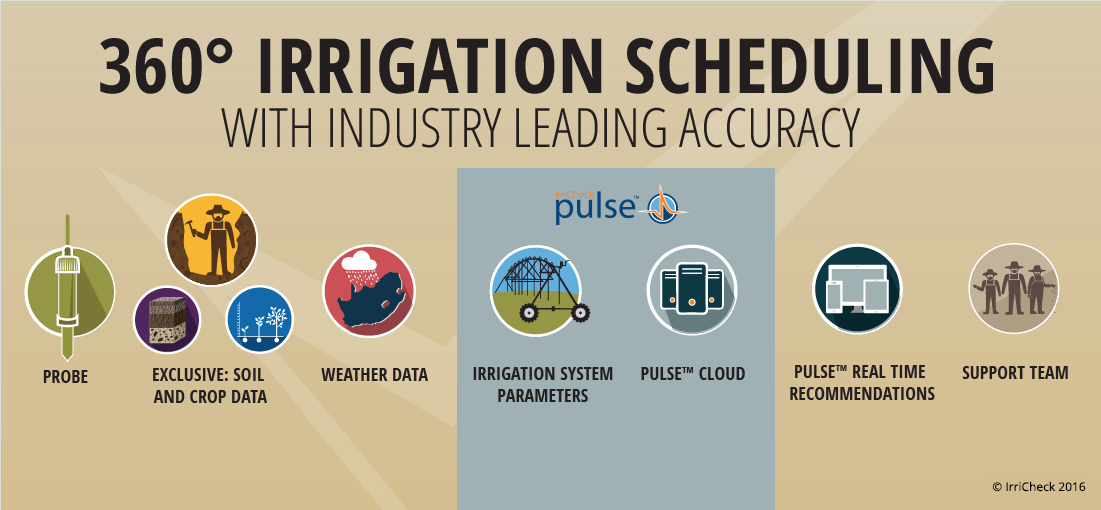
The hourly simulation model integrates all the variables and parameters of the Crop - Soil - Atmosphere System as well as the management decisions, in order to simulate the soil water depletion in the soil.  Examples of the variables and parameters taken into account, is:

  • hourly measured soil moisture at six depths (using DFM's capacitive probes) which is calibrated to mm/m in each field
  • measured weather data which is used to calculate the evaporative demand using the Penman-Montieth equation
  • Predicted weather from the local weather bureau, which is used to calculate the expected Evaporative demand using the Penman-Montieth equation
  • The Field capacity of each of the six layers of the soil profile
  • The properties of the irrigation system, such as type of irrigation, application rate, extend to which foliar is wetted, etc.
  • The expected crop coefficients for the different stages of the growing season
  • The existence or not and % cover of mulch, which will reduce evaporation and intercept rain and irrigation
  • The existence or not and % cover of  weeds, which will use additional water and intercept rain and irrigation
  • The managers decision of allowable depletion levels for the top soil (scheduling depth) and the bottom soil
Other outstanding features of the system:
  • The ability to determine the crop coefficient. The system measures both components of the crop coefficient, which is the ratio between the water used and the evaporative demand for the same day. The crop coefficient is therefore actually measured daily.  Therefore the normal process which is followed during research, is executed on each field. Therefore in the graph below (in the second graph from below on the right) the actual crop coefficient is the ratio before water supply becomes limiting and the ratio starts to drop.  
  • The ability to determine the depletion level at which crop water stress initiates, which is the maximum refill amount for the specific crop on the specific soil. This information is crucial for optimising irrigation efficiency by minimising evaporation losses through longer irrigation frequencies with higher irrigation quantities. In the Actual Use/ED (ED = Evaporative Demand) graph below it can be seen how the ratio stays constant for a few days until supply becomes limiting. After that the ratios declines, indicating stress.  In the top soil graph it can be seen that this happens when the deficit exceeds 20mm.  The water use includes evaporation losses, which explains the higher ratios shortly after irrigations.   The data in the graph was measured without using the Irricheck Scheduling program.  The information was revealed after importing the data into the Irricheck software. The data clearly indicates that the irrigation intervals is too long and that stress is induced by the end of each irrigation interval.  These table grapes resulted in small berry size because they were so frequently stressed, which could have been avoided by efficient scheduling. 
Cropfactor First Stress


Communication features

 The Irricheck software contains numerous functions which enables farmers and consultants to utilise internet technology to enable and speed up the functions of the consultant.  

  • The Irricheck Scheduling program can send the recommendation to users by SMS or email
  • Uploading and downloading of datasets to the Irricheck website: Especially when a physical visit from the consultant is not necessary or possible, the dataset can be uploaded very easily to Irricheck's web-site. The consultant can download it, check and refine it and upload it again. After downloading it again, the farmer can continue scheduling as normal.
  • Sending an email with a screenshot attached: A farmer can easily bring anything to the attention of his consultant by pressing the F2 function.  The program will prompt him to write a note and will automatically attach a screen shot to the email which is sent immediately to the consultant.
  • SMS notifications: The program can notify anybody, according to the clients needs of several different situations, which need attention. This function helps to ensure that certain urgent situations are attended to quickly. Examples: SMS the technician if a probe battery should be replaced, SMS the supplier of the probe if the probe readings are unstable, SMS the manager if the deficit in a field is exceeding the allowable depletion with more than 20% (variable to be set).


The web based Irrigation Scheduling database

This feature allows data to be shared on the internet. The Irricheck website generates the recommendation and the summarizing graphs of each field and publish it, to be available to each registered user of the company. In this way the scheduling can be delegated to a lower level manager and the results can be supervised by any other manager at any place globally.


Irrigation Scheduling system for Corporate (bigger farming businesses)

In big farming enterprises, where several farms in different areas are managed, there is a need to share the data between lower- middle- and top level management. In Irricheck's experience, we have found that it is best to empower lower levels of management to make accurate irrigation scheduling decisions and then decentralise decisions together with the responsibility. This can be done if full data is continuously available to management in middle and top levels to check frequently that the desired outcome is reached.

With this in mind, the following application of the system is suggested:

  • On each farm the Irrigation Scheduling program is operated in the normal way, but with the following two features activated. The program will automatically upload its data every time when new probe data is imported. The dataset is set up by the consultant in run-only mode. In this mode the farm manager will not be able to change any settings. It will be the consultant's sole responsibility.
  • The data on the web-based database then always contains the newest data. A Web based Irrigation scheduling program loads the newest recommendation and the graph containing all data of every field. Any registered user can see the data whenever he/she needs to. This data can also be made available to other management systems like GPS based prescision farming database systems.
  • The consultant, whether internal or external to the company, can download the newest dataset for any farm at any point in time in order to check the data and refine the settings. He uploads the dataset afterwards and the Irricheck Program on the farm will automatically detect it and download it.
  • The system can send notifications to anyone, reminding them of situations that need their attention.
Last Updated on Tuesday, 21 February 2012 19:30
 

Login

To view Scheduling data for your farm please log in below.


2012 - Irricheck Irrigation Scheduling. .